
Guest Essay: The birthday gift
Celebrating what we may not have anymore
Please consider supporting The Front Page with a paid subscription: HERE
By AARON WOOLF
By the time you read this, another Fourth of July will have come and gone. The flags will be folded away, the grills scrubbed clean. And the smoke from the fireworks will have drifted up from Marcy Field, through the low col at Little Porter, and out over a forest that has endured revolutions, civil wars, depressions, hurricanes, and now another Fourth of July.
Birthdays are never really about the day itself. They are occasions for taking stock. They ask us not simply to celebrate another year, but to wonder what, exactly, has endured long enough to deserve celebrating.
This year’s birthday was no ordinary one. Two hundred and fifty years since the signing of the Declaration of Independence—a round number that inevitably summoned memories of past anniversaries, each preserved in the visual language of its era: Currier and Ives prints for the Centennial, scan-lined television for the Bicentennial.
And now, somehow, we have persisted for a quarter millennium.
It’s an astonishing milestone for any nation, especially one founded upon so improbable an idea: that ordinary people might govern themselves.
Yet as this anniversary approached, I found myself asking a question I had never before associated so sharply with the Fourth of July.
What exactly are we celebrating?
The idea of asking questions at the sight of fireworks first entered my mind years ago because of my cousin, Larry Gwin.
Larry fought in Vietnam. Years later, he wrote a searing memoir of that experience titled Baptism. You should read it.
He does not enjoy fireworks. They are simply too close to the sounds and flashes of battle that have never entirely left him.
Until Larry, fireworks had always meant only one thing to me.
Celebration.
Childhood.
Innocence.
The smell of sulfur drifting through warm July air while we lay on blankets waiting for the next impossible blossoming of red, white, and gold overhead.
Larry gave me an unexpected gift. He taught me that even fireworks can contain more than one truth. It occurred to me that if I was going to think honestly about America’s 250th birthday, I would have to remember how to hold multiple truths together rather than choose between them.
What better way than through conversation?
So on Independence Day eve, I met Ross Whaley for coffee.
Ross has had one of those improbable American lives that, for much of our history, were improbably common. Born in Detroit to Canadian parents, a self-described mediocre student who never planned to attend college, he was repeatedly lifted forward by teachers and mentors who saw possibilities in him before he saw them in himself. He would eventually become president of SUNY’s College of Environmental Science and Forestry, chairman of the Adirondack Park Agency, and one of the wisest people I know.
None of that, however, was why I wanted to see him.
I wanted company.
I didn’t want to think about America’s birthday alone.
So I asked Ross the first question that had come to mind.
“When you think back to your childhood,” I asked, “what was one of the first moments when you became aware of being an American?”
Ross smiled.
“Well,” he said, “my mother, father and brother were all Canadians. I was the American child.”
His first memories of America were not flags or parades but war.
“My awareness of World War II,” he recalled, “was the newsreels... the pictures of the fighters.”
Then he paused, as though another memory had surfaced while he was speaking.
“I was about to say that I never thought of my folks as being particularly patriotic. Until right now, when you asked the question...”
He smiled again.
“My mother—this was not like her—became a riveter on B-29 planes.”
Immediately I thought of Rosie the Riveter.
Except Rosie wasn’t a poster.
She was Ross’s mother.
An ordinary woman. A Canadian immigrant. Someone who probably never imagined that decades later her son would recall that quiet act of service as one of his first memories of being an American.
Again and again, Ross returned not to his own accomplishments but to the people who had altered his course: the mother who persuaded an indifferent high school student to attend a college night he had no interest in attending, the professor who noticed something in a summer employee, and the mentors who opened one opportunity after another.
“I consider myself the most blessed person in the world,” he told me. “I had unbelievable opportunities, and I can’t take responsibility or credit for any of it. It was the surroundings in which I lived, the people with whom I connected, that gave me an unbelievable life.”
Listening to Ross, I found myself thinking less about the man across the table than about the country that had made such a life possible.
The conversation wandered from there, as conversations worth having usually do. We talked about immigration and gratitude, parents and teachers, faith and forests. But every so often, like a river returning to its main current, we found ourselves drawn back to the reason we had met in the first place.
It was America’s birthday. Before long we found ourselves sharing memories about another one.
Ross had already lived through much more of America’s story than I had by the summer of 1976. Yet despite the years between us, we found ourselves remembering much the same celebration.
The tall ships.
The parades.
That great red, white, and blue star logo that seemed to appear everywhere.
What strikes me now about 1976 is not the celebration itself but its timing. The nation had just emerged from Vietnam. Richard Nixon had resigned the presidency in disgrace. Confidence in government had been shaken, and there was no shortage of reasons to wonder whether the country’s best years were already behind it.
Looking back, it would be easy to say we celebrated despite the wounds of those years. I think we celebrated because we believed they could heal.
There was, even then, a confidence that now feels harder to find—not confidence that America was perfect, but confidence that it remained capable of correcting itself.
Ross sat for a moment before speaking.
“I think in 1976,” he said, “I learned that we weren’t perfect. But that was all right, because we weren’t perfect—and we were going to fix it.”
Fix it.
I found myself returning to those two words long after our conversation moved on.
But Ross himself was no longer sure the words still applied.
He told me he struggled to understand something happening now that hadn’t confused him in decades past. It wasn’t the disagreement itself — disagreement, he said, had always been part of the country’s arrangement. What baffled him was watching people confront a shared problem and choose contempt over repair, choose to demean rather than sit down and work it out. If it were some smaller fraction of the country, he said, he thought he could get his mind around it. He couldn’t anymore.
That admission clarified something I had been struggling to articulate throughout this anniversary year. America’s failures have never been the source of my deepest anxiety. We have always fallen short of our ideals.
What unsettles me today is something different. I worry less about our imperfections than about the qualities we have begun to reward. Vanity instead of humility. Celebrity instead of ordinary citizenship. Certainty instead of curiosity. Winning instead of repairing.
Those seem to me less like political differences than civic ones. They are habits of mind, habits of character. They force a deeper question.
Can ordinary people still govern themselves?
That question followed us into the woods.
I asked Ross whether a lifetime spent studying forests had taught him anything about the moment in which we find ourselves.
His answer surprised me once again.
He spoke about forests not as collections of trees, but as communities. About reciprocity. About the extraordinary ways scientists are only now beginning to understand how trees nourish one another, recover after disturbance, and prepare the conditions for future generations. He spoke admiringly of indigenous traditions that understood these relationships long before ecologists found ways to describe them.
Then, as he has many times since she died, he began talking about his late wife, Beverly.
“I’ve always been the head person,” he said. “Beverly was the heart person.”
As they walked together through the woods, Ross saw Acer saccharum. Sugar maple.
He saw Abies balsamea. Balsam fir.
Beverly saw beauty.
“She was always teaching me to slow down,” he said.
Even after a lifetime spent among forests, Ross told me he was still trying to learn to see the woods the way she did.
That may have been the most hopeful thing he said all afternoon—not because he had arrived, but because, well into his 80s, he was still willing to be changed.
I wondered whether we still are.
Healthy forests are not sustained by a single magnificent tree.
They endure because countless ordinary organisms spend their lives creating the conditions that allow others to flourish. The tallest trees depend upon networks they can scarcely see. Perhaps healthy republics are no different.
Walking back across Marcy Field that evening, as the last smoke drifted out across the darkening forest, I realized Larry and Ross had given me remarkably similar gifts.
Larry had taught me to hear fireworks differently. Ross had taught me to see forests differently. Together they had answered the question I had carried into our conversation that morning.
What do we celebrate on the Fourth of July?
Certainly we celebrate our independence. But perhaps we celebrate something quieter as well: the ordinary citizen who quietly assumes responsibility for someone else’s future. The woman riveting airplanes. The teacher who notices promise in a distracted student. The mentor who opens one more door than required. The countless acts of stewardship that rarely appear in history books, yet without which self-government cannot endure.
Whether we still possess enough of those habits to repair what is broken, I honestly don’t know. It may take several more Fourths of July before we find out.
Ross reminded me that what he remembered most about the Bicentennial was not believing we were perfect. It was believing, as he put it, that “we were going to fix it.”
Fireworks commemorate the nation’s birth.
Forests remind us how nations endure.
Perhaps the real miracle was never that ordinary people might govern themselves.
It was that, generation after generation, ordinary people created the conditions under which self-government could flourish.
Movie night
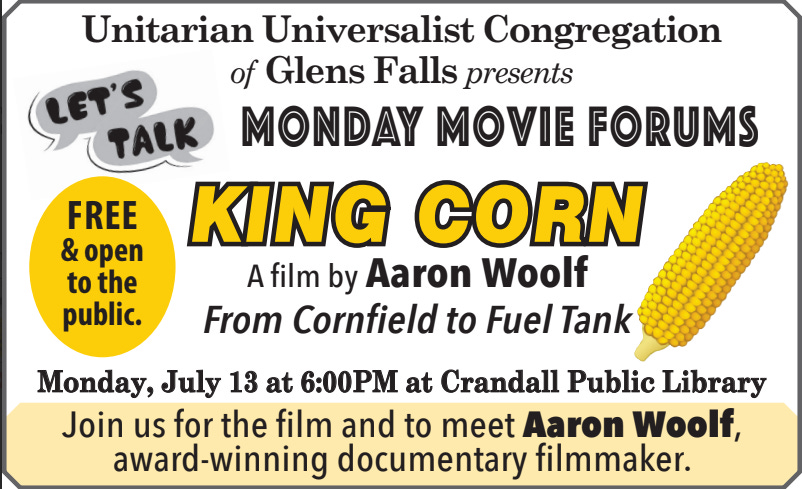
Elizabethtown filmmaker Aaron Woolf speaks at Crandall Public Library at 6 p.m. Monday, July 13 as part of the “Let’s Talk” Monday Night Film Forum series sponsored by the Social Justice Committee of the Unitarian Universalist Congregation of Glens Falls.
The film being presented is “King Corn,” which Woolf directed and produced. The film follows a personal journey that explores how government policies, industrial agriculture and market forces have made corn a dominant crop in the U.S. at the cost of harm to the environment and public health.
Joining Woolf as co-host is Marion Trieste, founder of United Solar Energy Supporter, whose focus is corn ethanol policy.
The film and follow-up discussion relate to the Federal Farm Bill currently extended through September 30 while negotiations continue concerning policy impact on small farms and rural communities, SNAP, corn ethanol and conservation and climate.
This essay by Aaron Woolf recalled for me the Overstory by Richard Powers. It won the Pulitzer Prize for fiction in 2018. The novel relates the fragility of trees, but they survive because they are a community. The importance of interdependence, cooperation, and regeneration are crucial to their survival.
Beautifully written. Thank you for the hopeful essay.