
Rushdie wasn't sure he would write again after attack
New Orleans Book Festival had something for everybody

Please consider supporting The Front Page with a paid subscription: HERE
When I entered Devlin Fieldhouse Friday morning, I saw more people than at any Tulane basketball game I attended this year.
This was to see Salman Rushdie, a 78-year-old man who definitely cannot dunk.
I confess I have never read any of Rushdie’s writings, but I knew his story. Nearly four decades ago, Iran’s supreme leader called for Rushdie’s death for his book “The Satanic Verses,” since the book was considered blasphemous to some Muslims. It seemed extreme, but perhaps an insight into the fanaticism in other parts of the world.
For years, Rushdie stayed out of sight.
But in 2022, a man rushed the stage during an event outside Buffalo and stabbed the author multiple times, costing him his right eye.
A stage just like the one in New Orleans this weekend.
There were two policemen in front of the stage.
Another policeman at each end of the stage.
And uniformed men wandering around near the stage.
And there was Rushdie standing there center stage being embraced by the New Orleans crowd.
Totally at ease.
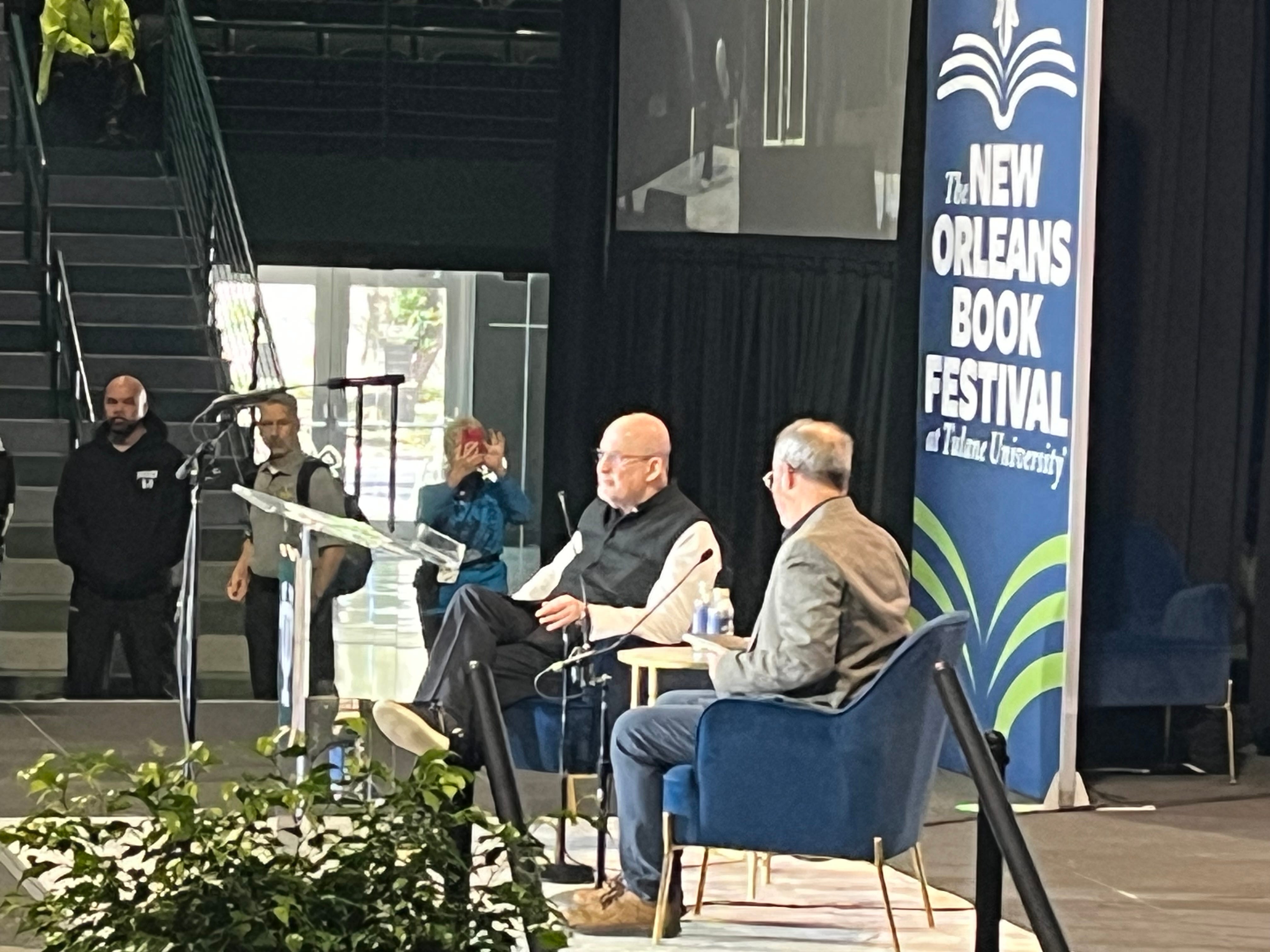
He was funny and insightful and clearly the smartest man in the room. And there were some smart people in the room.
The Atlantic writer George Packer, who conducted the interview, pointed out that, since the attack, Rushdie has published a novel, a memoir about the attack and his recovery and another book of short stories.
He may have lost his eye but not his ability to write.
But that was not true, at first, Rushdie said.
Rushdie’s agent insisted almost immediately that the author should write about the attack.
Rushdie said he wasn’t sure he would ever write about it.
“He (his agent) understood it was not possible for me to heal and write about anything else until I dealt with this,” Rushdie said.
He was right.
“I never thought it would be a book,” Rushdie said. “I would write 20 pages about the attack and that would be it. The first chapter is about what happened. The rest is thinking about it.”
So he kept going.
“Knife: Meditations After an Attempted Murder” covers his healing journey through art, love and support from his family.
“The only way to get past it was to get through it,” Rushdie said.
He described the story structure as a triangle, with him at one point, his wife’s love at another and death the third point.
“It was like a true crime story, but it’s a love story,” Rushdie said. “I’m not good at being the victim. I don’t feel sympathetic. I’m a working writer trying to do work.
“I was worried I wouldn’t be able to write fiction anymore because of trauma, the shocking impact of what happened, so I was relieved when suddenly there was make-believe coming out of my head.”
Which resulted in his latest collection of short stories, although even the writer seemed to wonder if they were all make-believe.
“There are two stories in there about revenge,” he said. “I don’t know why I’m thinking about that. It’s a mystery.”
The man who attacked Rushdie was convicted and sentenced to 25 years in prison.
The Chautauqua County judge told the attacker during sentencing that his attack was against something larger than just one person, the right to free expression.
“It goes to the very heart of what our country stands for,” Judge David Foley said.
So at 78, Salman Rushdie sat there on the stage as defiant as ever.

Book festival
For three days this weekend, words and books were the centerpiece of a city known for food and jazz.
More than 2,000 filled every seat of McAllister Hall on opening night to see Ken Burns and Gen. Stanley McChrystal speak.
But here is what is even more impressive: Beginning each morning at 10 a.m. in session after session, the same venue was filled again and again and again, and if you didn’t like what was playing there, there were another eight venues to choose from as thousands swarmed all over the Tulane campus, patiently waiting in line for the people who write the words.
Besides Rushdie and Burns, there were Andrew Ross Sorkin, David Rubenstein, John Avlon, Walter Isaacson, David Brooks, Adm. William McRaven, Anderson Cooper, Kenny Chesney, Stacey Abrams, Eddie Glaude Jr., Charles Blow, Gov. Wes Moore of Maryland, Kara Swisher, Gen. David Petraeus, Rick Atkinson, Michale Lewis, Jon Meacham, Dr. Sanjay Gupta and Tim Miller.
That’s a lot of star power selling books.
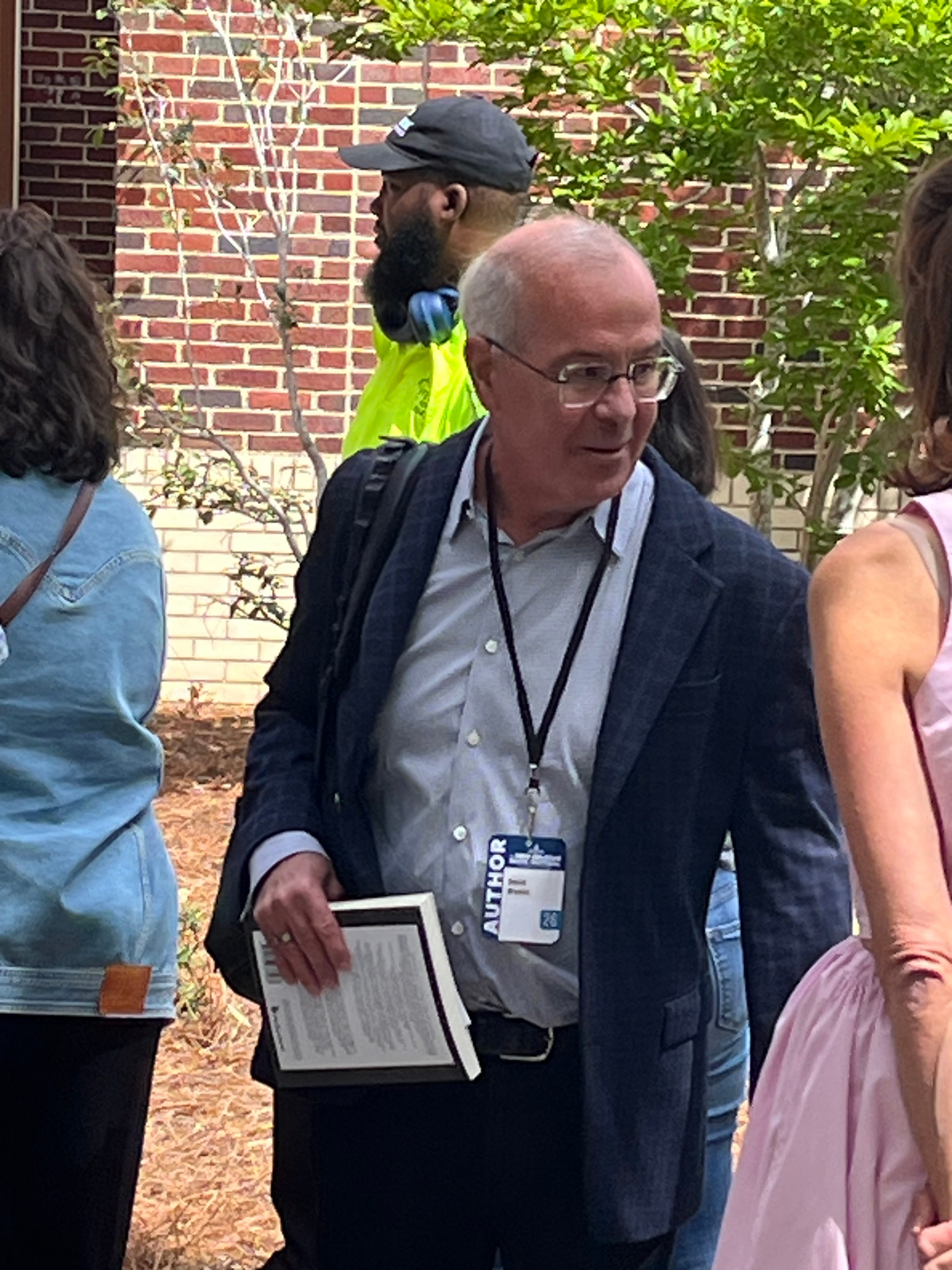
I got to meet David Brooks, one of my favorite columnists when he worked at the New York Times, and since I had read so many of his books, gave him a copy of my book to read.
He said he’d check it out.
At one point while interviewing Rushdie, George Packer, an investigative journalist for The Atlantic, lamented the decline of books and the printed word.
Rushdie did not miss a beat.
“Americans are not the only people in the world,” he said to the loud applause of a room full of Americans.
Lion’s den
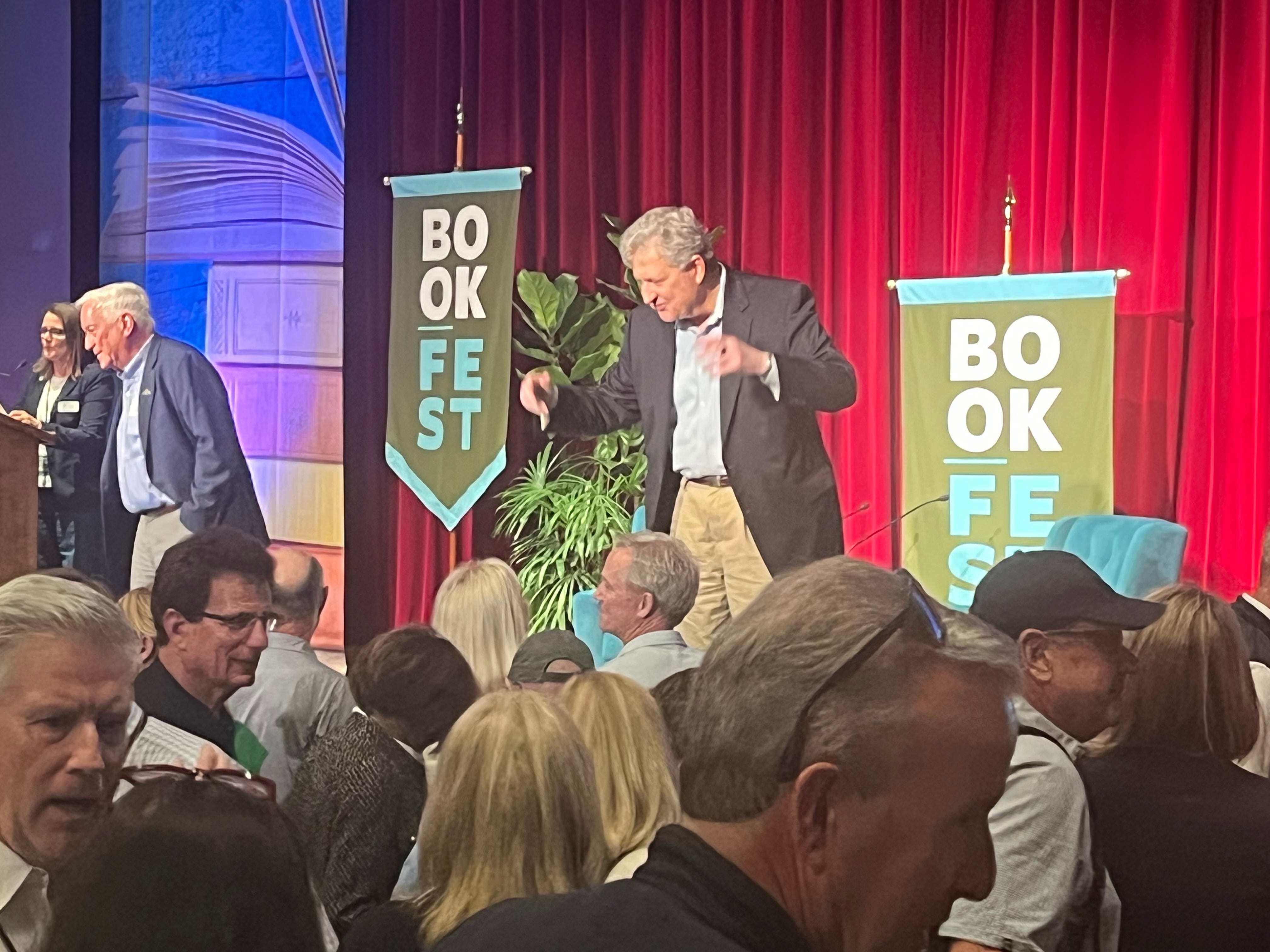
It was announced on Saturday that Louisiana Sen. John Kennedy was a late addition to the book festival lineup, with celebrated author and New Orleans native Walter Isaacson engaging him in conversation.
If you’ve seen Kennedy on TV, he has this country bumpkin charm as if he just fell off the turnip truck, and while he was born in Mississippi and raised in the small town of Zachary, La. he did graduate from Vanderbilt, the University of Virginia Law School and then Oxford.
Isaacson’s first question was about how advanced institutions of learning put a shine on a person, but that did not seem the case for Kennedy.
“I grew up in Zachary, Louisiana,” Kennedy said. “And the only two things I was interested in were basketball and cheerleaders, and I wasn’t very good at either.”
That’s Kennedy’s folksy charm.
He has made news lately for going toe to toe with Homeland Security Secretary Kristy Noem over her spending $220 million on television ads that featured her.
Kennedy said he talked to President Trump a few hours later and he was “pissed.”
Noem got fired a few hours later.
When he was asked about the immigration policy, Kennedy surprised the crowd by saying, “Every human being has the right to dignity,” then adding, “To a bear, we all taste like chicken.”
That’s Kennedy.
When asked about the events in Minneapolis, Kennedy insisted that no one had the right to protest violently.
While many in the crowd mumbled and shook their heads, Isaacson quickly interjected, “That was not the case there!” to the applause of the crowd.
You have to give Kennedy credit for making the trip to liberal New Orleans where, over the weekend, few in the crowd showed much appreciation for President Trump’s policies.
When Kennedy walked on stage, he saw James Carville, President Clinton’s longtime political operative, who is also a New Orleans resident.
“Did anybody search this man?” Kennedy said, laughing, before leaning down to shake Carville’s hand.
Before the event started, Mitch Landrieu, the former mayor and lieutenant governor of Louisiana, came out and told the crowd to “behave yourselves.”
When Isaacson asked about the Iran war and what its goals are, Kennedy deflected the question, saying “I don’t know. I have enough trouble running my own life.”
And when Isaacson asked about Trump’s contradictions concerning the war, Kennedy said, “President Trump gets anxious whenever he has an unexpressed thought,” to more laughter from the crowd.
Not sure if we learned anything, but it was a good show.
Lemon appearance
Don Lemon, the former CNN host who recently was arrested in Minneapolis for his reporting, appeared at a session on Saturday, where he described President Trump’s interest in makeup, shoes and interior decorating and said, “Donald Trump is the gayest president in history.”
Lemon is gay.
He also said about the Trump administration officials, “Ya know, karma is a bitch. They all are going to suffer some consequences.”
NOLA mayor
New Orleans Mayor Helena Moreno, a Democrat who just started her first term, was asked about her relationship with Republican Gov. Jeff Landry.
She explained she was shocked when serving in the Legislature how much New Orleans was criticized for its spending, especially since the city was responsible for enormous revenues for the rest of the state.
“This is how it has always been,” Moreno said. “The rest of the state has always been against New Orleans, and New Orleans has always been against the rest of the state.”
Ken Tingley spent more than four decades working in small community newspapers in upstate New York. Since retirement in 2020 he has written three books and his play “The Last American Newspaper” is being produced by Capital Repertory Theatre in Albany Sept. 25 to Oct. 18 . He currently lives in both Queensbury, N.Y. and New Orleans, La.
I always try to have a book on me if I go someplace where there may be downtime. Hearing about the book fest makes me happy I’m not alone! My daughter’s friend said recently that people reading books in public anymore is seen as performative. I said only if you’re schlepping around Finnegan’s Wake or Gravity’s Rainbow. A paperback novel from the Little Free Library marks me as one of the simple common folk!
The “folksy shtick” of Senator John Kennedy is entertaining at times. But buyer beware. Kennedy is an opportunist. He ran a number of times as a Democrat but had little luck. So he switched parties and found success.