
Perhaps my epitaph should be one of a `tombstone tourist'
Evidence overwhelming that Trump administration is most corrupt in American history

Please consider supporting The Front Page with a paid subscription: HERE
Perhaps, my final epitaph should say I was a tombstone tourist.
One of those people who wander through graveyards in search of celebrity headstones and clever final words.
A graver wondering about the lives of the dearly departed.
I was surprised to find there is even a word for it — tapophile — lover of cemeteries.
Yet, oddly, I want to be cremated, so I suspect that is not in the cards.
It started for me with the Dead Presidents Society 40 years ago, when a friend visiting me in Tennessee wanted to see where President Andrew Johnson was buried (Greeneville, Tenn).
And I was hooked.
When I visited Ronald Reagan’s presidential library a couple of years ago, I had completed the mission of visiting every chief executive’s grave. Then, Jimmy Carter died.
I hope to pay him a visit next week.
Along the way, I discovered one of my cousins had also taken up the hobby, and now my son has joined me and we’ve expanded our interests to anyone of historical interest.
We tromped around Arlington National Cemetery on a pleasant December afternoon and visited the graves of astronauts, government officials only we would care about and a Civil War general named Abner Doubleday who allegedly invented baseball. There were baseballs left all around the gravesite.
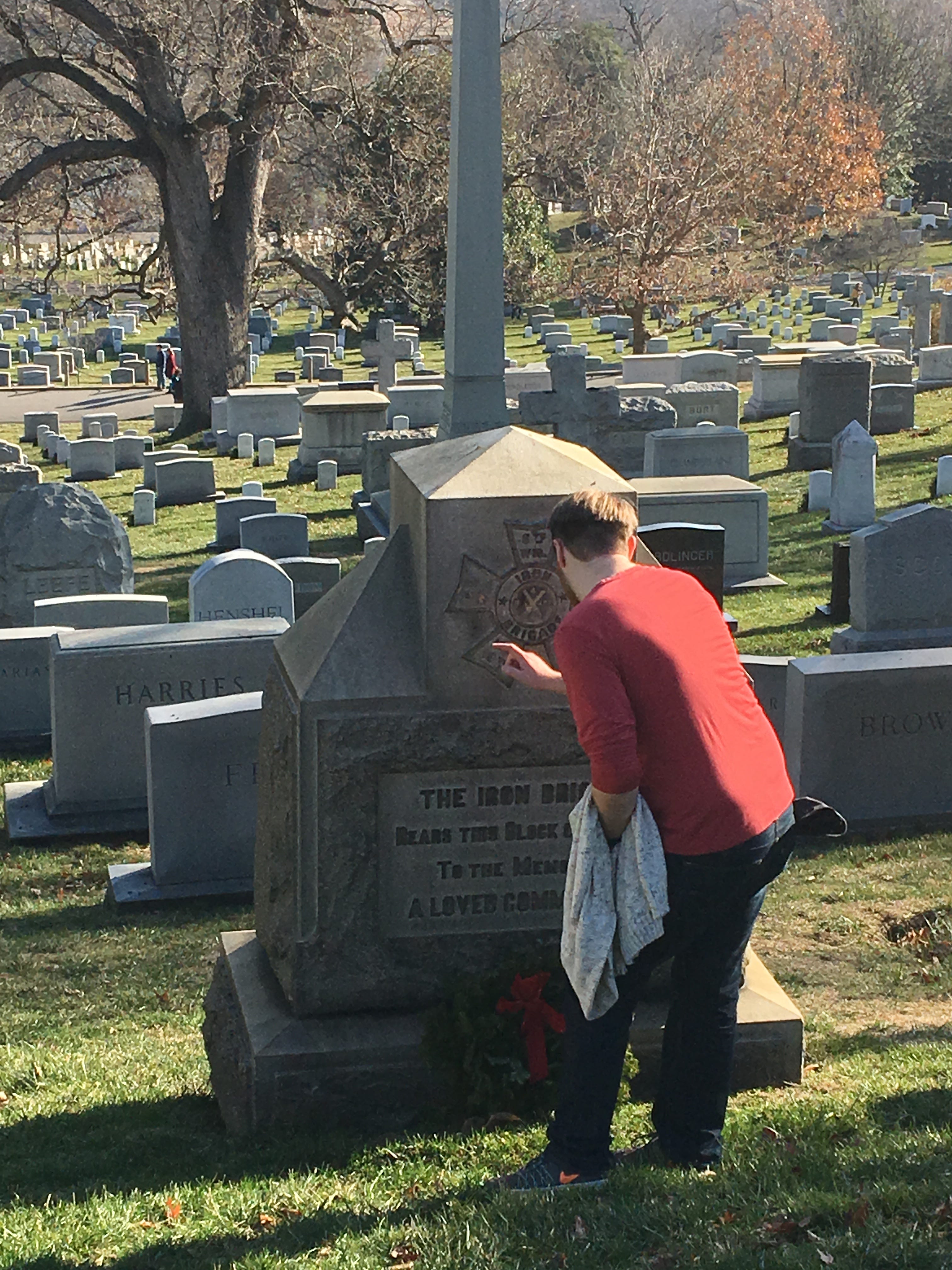
My son searched out the final resting place of a man named Jonathan Letterman who was the medical director of the Army of the Potomac during the Civil War. Joseph explained to his Dad that Letterman “basically revolutionized battlefield casualty evacuation” and even provided me with a quote from a surgeon during World War II who said, “There was not a day during WWII that I did not thank God for Jonathan Letterman.”
I wondered then — and sometimes now — what have I created?
During the pandemic, we made a trip to a rural cemetery in Vermont so my son could search out Thomas W. Salmon, head of neuropsychiatry for American forces during World War I. He had done his capstone research project on the early research by Salmon into PTSD.
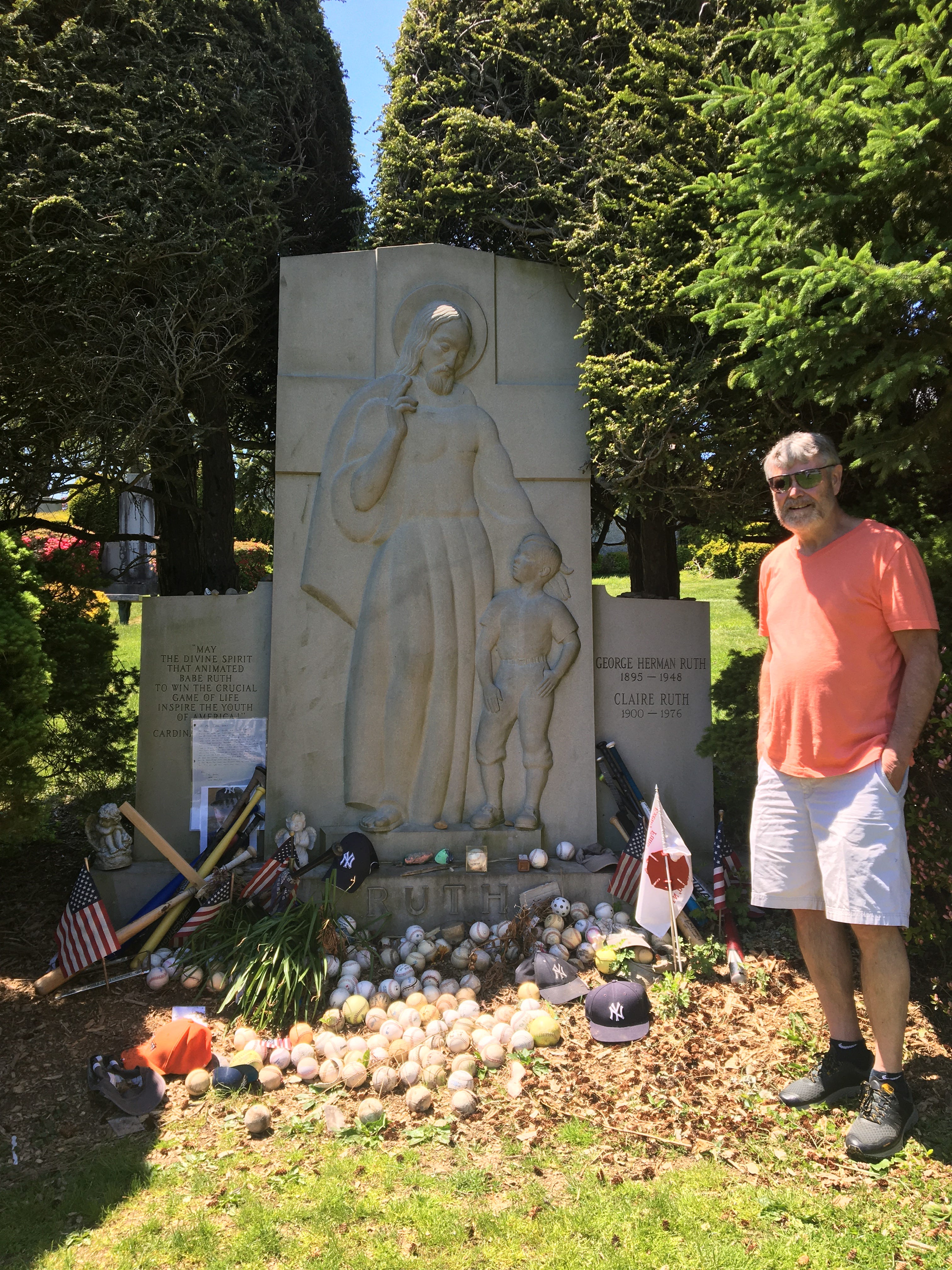
We made another trip to Westchester County to see the graves of Babe Ruth, Lou Gehrig and Billy Martin — all former Yankees and obviously my idea — then stumbled on to Malcom X’s final resting place while failing to find entertainer Ed Sullivan in the nearby mausoleum.
You may be wondering what is wrong with us by now.
On another trip to Gettysburg, Pa., I veered off course to visit the gravesite of Olympian Jim Thorpe in Jim Thorpe, Pennsylvania, where the story goes that the town got Thorpe’s corpse in exchange for naming the town after him.
Another time, I did a side trip to Stockbridge, Mass. to see Norman Rockwell’s grave. If you ever visit the museum, stop by, it’s close to downtown.
This weekend, my son and I spent Sunday morning at the Lake Lawn Metairie Cemetery in New Orleans. There aren’t many cemeteries like it. The historic 127-acre burial ground is known to have the largest collection of marble tombs.
Driving through the grounds, you get the feeling you’re in a miniature suburban development where all the neighbors are quiet.
The architecture of the tombs is often opulent and ornate, punctuated with crosses and the largest collection of funeral statuary in the city.
There are more than 120,000 people resting here, including nine governors, 12 New Orleans mayors and a millionaires row of the rich and powerful, but we weren’t there to see any of those.
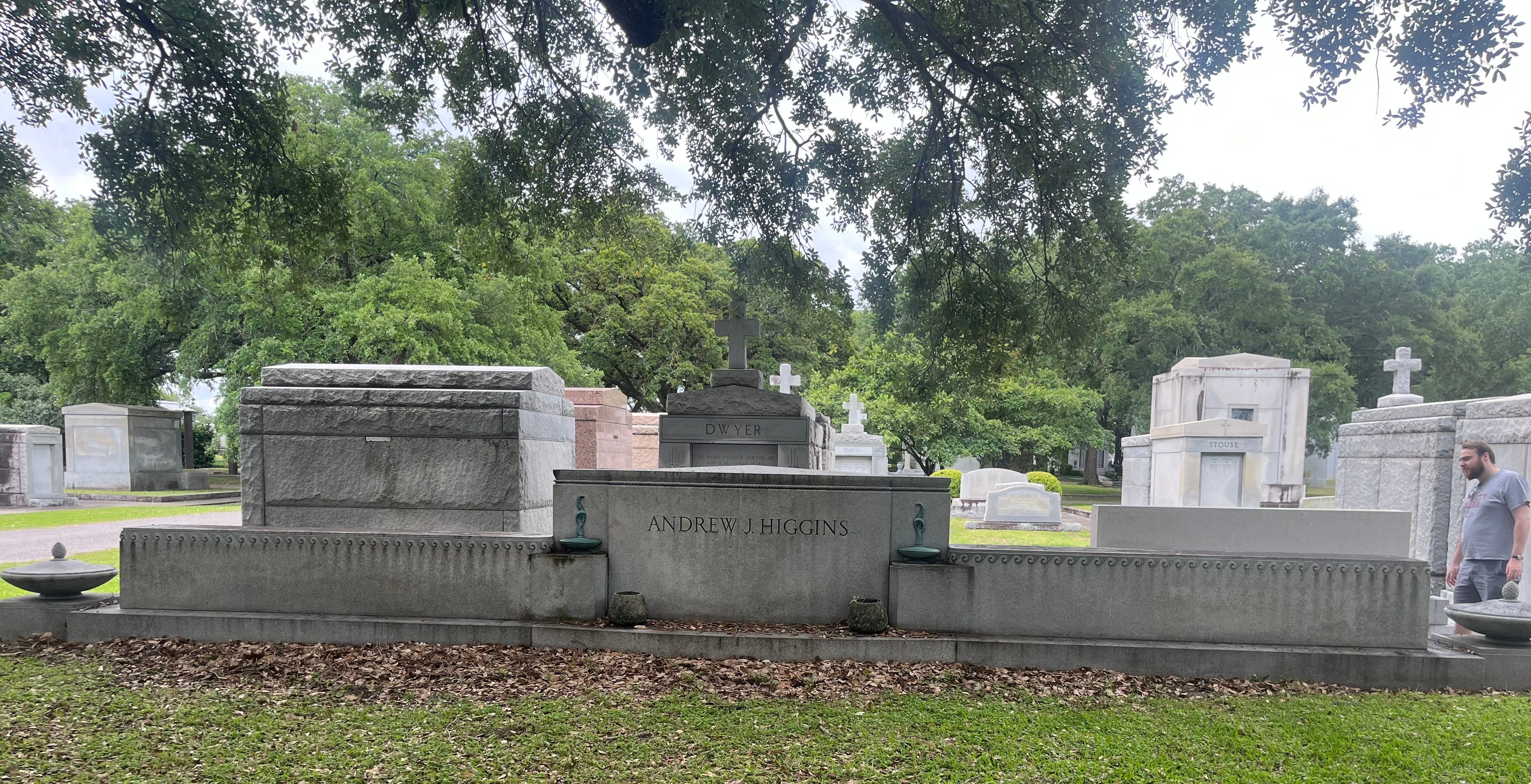
For my son, it was a chance to see the final resting place of Andrew Higgins, the New Orleans businessman whose design of a landing craft during World War II was an important contribution to the success of D-Day and amphibious landings all across the Pacific.
It is the reason that the National World War II Museum — formerly the D-Day Museum — is based in New Orleans. President Eisenhower reportedly said Higgins won the U.S. the war.
Last summer, my son did a presentation at the National World War II Museum about Higgins and his legacy, so this was special for him.
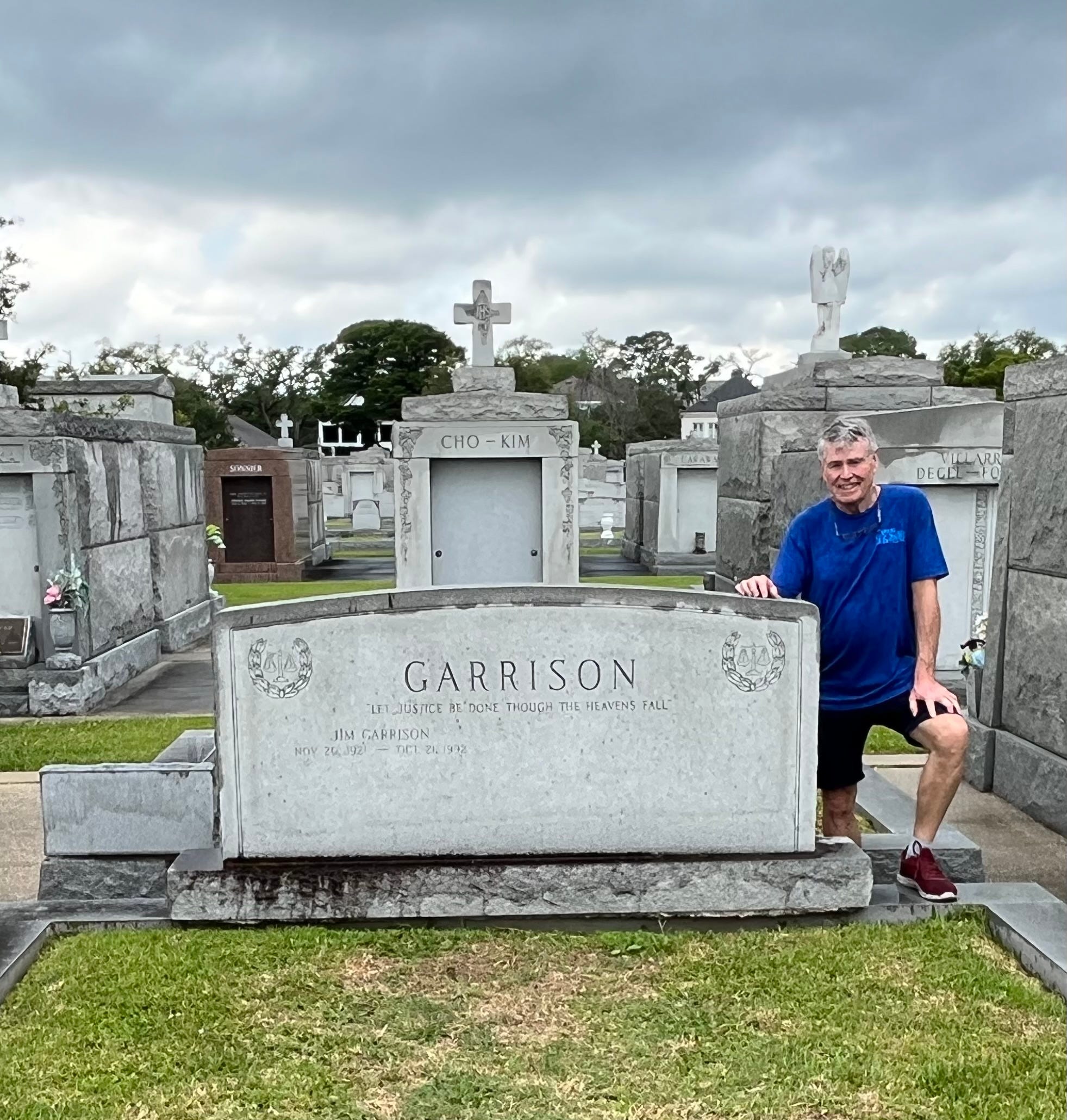
For me, as a reformed conspiracy theorist of the Kennedy assassination, I was chasing New Orleans’ former District Attorney Jim Garrison. If you saw Oliver Stone’s movie JFK, Kevin Costner played Garrison as the only person ever to bring a criminal case of conspiracy in the murder of President Kennedy.
In both cases, while their headstones were large, the information about who they were and what they did during their lives was nonexistent.
Only Higgins’ name was on his 30-foot-long headstone.
Garrison also had his motto — an old Latin legal maxim that was prominently used in the movie — “Let justice be done though the heavens fall.”
The cemetery was originally the site of the Metairie Race Course, but during the Civil War it was closed and temporarily used as a Confederate Army campsite.
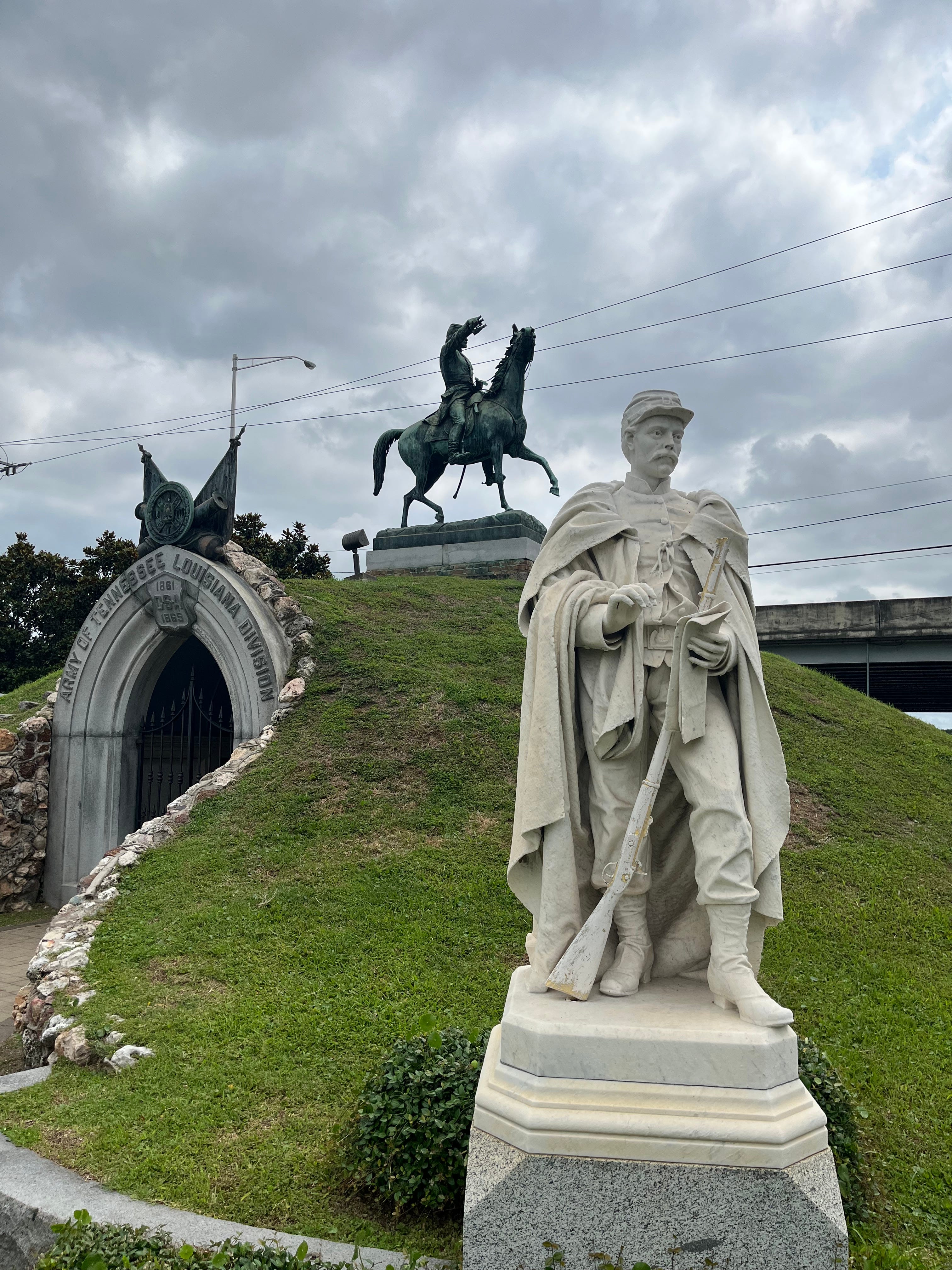
It is now the final resting place of two prominent Confederate generals and a monument to the Army of Tennessee, Louisiana Division, where General P.G.T. Beauregard is buried.
Atop the monument is an 1877 equestrian statue of General Albert Sidney Johnston, who was buried here for a time before his remains were moved to Texas. At the entrance is a life-sized statue of a Confederate officer about to read the roll of the dead during the Civil War. In another part of the cemetery is buried Gen. John Bell Hood.
We also found “Interview with a Vampire” author Anne Rice’s grave.
I could have spent all day there.
There is a pseudo-Egyptian pyramid.
A special railroad spur was needed to transport the stone to the 60-foot-high “Moriarty” tomb and monument right next door to the marble tomb for New Orleans Saints owner Tom Benson, complete with the Saints’ fleur de lis emblem at the entrance.
I read later about one tomb — restaurateur Ruth Fertel’s mausoleum — that cost between $125,000 and $500,000 in late 20th Century dollars.
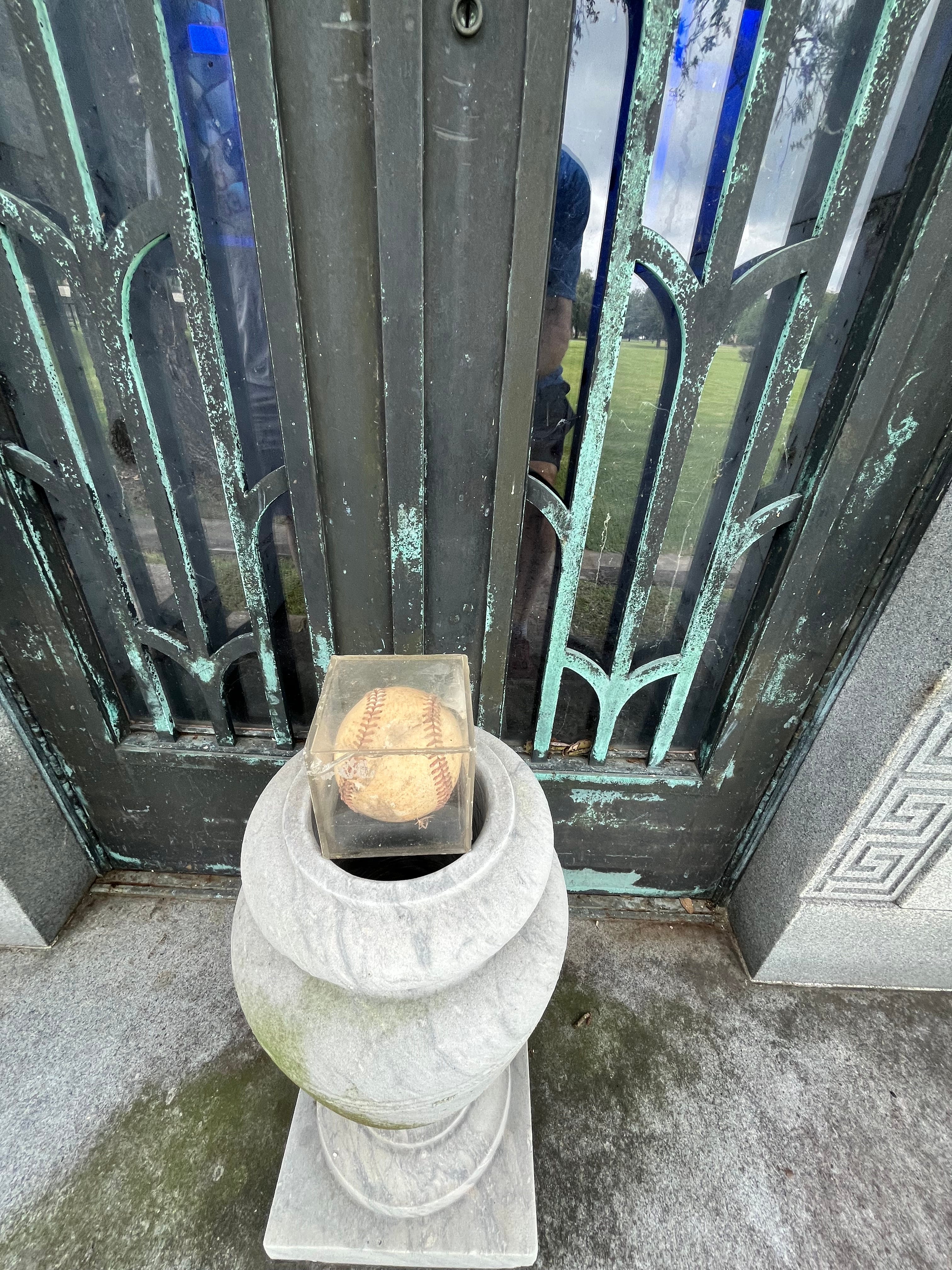
I also managed to find the grave for baseball Hall of Famer Mel Ott. He hit 511 home runs for the New York Giants in the 1930s despite a diminutive presence that earned him the nickname “The Little Giant.” Out front there was a baseball sealed in a case.
It was a good day to be alive.
I suspect we will be be back again, but just for a visit.
Fighting fraud?
Politicians talk a lot about finding and fighting fraud in government.
But with each new investigative piece of journalism, it is becoming more and more clear that the Trump administration, not the federal government as a whole, is rife with corruption.
Substack columnist Heather Cox Richardson recently wrote the Trump corruption is “mind-boggling:”
“He has fired or demoted twenty inspectors general—the people key to oversight—and in 2024 alone the people he has since fired or sidelined identified more than $50 billion in waste and abuse.
“Trump has also pardoned or commuted the sentences of more than 70 donors or allies who were convicted of fraud. One, Philip Esformes, was convicted of stealing $1.3 billion from Medicare.”
She also pointed out the Trumps have pocketed about $4 billion, primarily through cryptocurrency enterprises, and that Trump’s sons, Eric and Don Jr., have invested in a drone manufacturer that is trying to sell weapons to Gulf countries currently at risk from the war Trump Sr. started in Iran.
In another egregious conflict of interest, the Pentagon recently awarded a $24 million contract to a robotics startup for which Eric is the “chief strategy adviser.”
Bloomberg News added this week that, during the first quarter of 2026, Trump or his investment advisers made more than 3,700 trades— over 40 a day—“totaling tens of millions of dollars and involving major companies that have dealings with his administration.”
Bloomberg also reminded its readers that Trump did not move his assets into a blind trust with an independent manager, as his predecessors did. Trump’s sons — Don Jr. and Eric — manage the business as it operates in areas that are directly related to government policies decided by Trump himself.
Cassidy loses
Sen. Bill Cassidy, a Louisiana Republican who voted to impeach Donald Trump after the Jan. 6 attack, finished third among three candidates in a Republican primary, ending his political career.
While Cassidy showed moral conviction in voting to convict Trump for Jan. 6, he let the country down when he became the deciding vote to approve Robert F. Kennedy Jr. as health secretary.
That decision will cost people their lives and it is what Cassidy should be remembered for.
More optimism
Longtime Associated Press reporter David Bauder, who recently retired after 40 years in the business, says he has optimism about the future of journalism.
“The thing about journalists is, instead of bemoaning the state of the industry as much as we do - because it’s been our job - they put their head down and work because it’s very important,” Bauder said on The Poynter Report Podcast. “They understand the importance of it and they love it. I mean it’s in your blood when you’re doing stuff like that. And I think there are enough people that want to do that sort of thing that makes me feel optimistic.”
That feels about right.
Forgetting the past
We seem to once again have forgotten the lessons of history.
Gerrymandering minorities out of representation takes us back to another time, when the Ku Klux Klan ruled local communities and murdered with impunity.
Substack columnist and historian Heather Cox Richardson recently reminded her readers about the three Civil Rights workers who were killed by the Klan in 1963 for trying to register Black voters.
Richardson reminds us that, at the time, the voting rolls in Selma, Alabama were 99 percent white even though Blacks outnumbered whites in the community. A judge at the time stopped local Black organizers from holding voter registration drives by prohibiting public gatherings of more than two people.
That led to the voting rights march and the showdown on the Edmund Pettus Bridge in Selma.
More than 2,000 marchers were arrested by the local sheriff until a federal court ordered the sheriff not to interfere. Instead, he implemented a literacy test to Black voters and not one passed.
That is the past of the American South.
That’s where we seem to be heading again.
Ken Tingley spent more than four decades working in small community newspapers in upstate New York. Since retirement in 2020 he has written three books and his play “The Last American Newspaper” is being produced by Capital Repertory Theatre in Albany Sept. 25 to Oct. 18 . He currently lives in both Queensbury, N.Y. and New Orleans, La.
The most corrupt indeed. The IRS will vow to never again audit the Trump Crime family. Republicans should be outraged. They're silent and compliant. If our local candidates support this lawless regime, they're not fit for office nor worthy of our vote. As saying goes "all politics are local". Let's begin at the local level and work up the ladder.
My mother loved graveyards. Passed it on to me. Our specialty is bizarre tomb inscriptions all over New England. My favorite, “she was a bad wife.” That was somewhere in Connecticut.