
Guest essay: The Geography of Grievance
Losers don't forget their humiliations

Please consider supporting The Front Page with a paid subscription: HERE
By AARON WOOLF
Birthdays have a way of opening conduits to the past.
I had been reading about the president’s summit trip to China, trying to decipher the subtext beneath the choreography — the odd long handshakes, the communiqués, the invocations of cooperation and respect that hover uneasily above discussions of tariffs, fentanyl, military power, and technological rivalry.
A kind of wormhole opened in my mind, carrying me not from my 62nd birthday into the future but backward 40 years to my 22nd.
I was living in Lima then, working for a Peruvian film company during the years when the Shining Path insurgency was tightening around the country like a slowly coiling wire. Bombings, blackouts, whispered warnings, and sudden eruptions of fear were becoming part of life.
One afternoon, I stepped out into the sunshine of Avenida Petit Thouars, a broad boulevard lined with dusty old ficus trees. For an important thoroughfare in the middle of Lima, the name sounded unmistakably French. That evening, at a gathering of friends, I asked who Petit Thouars had been.
Everyone knew immediately.
“He’s the savior of Lima.”
The answer came not as trivia, but inheritance.
I learned that Abel-Nicolas Bergasse du Petit-Thouars was a French naval officer associated with the War of the Pacific, the catastrophic 19th century conflict in which Peru lost territory, prestige, and a sense of national invulnerability to an upstart Chile. According to Peruvian historical memory, Petit-Thouars helped spare Lima from destruction during the Chilean occupation. Perhaps he did.
What lingered with me was the feverish immediacy with which the war was remembered.
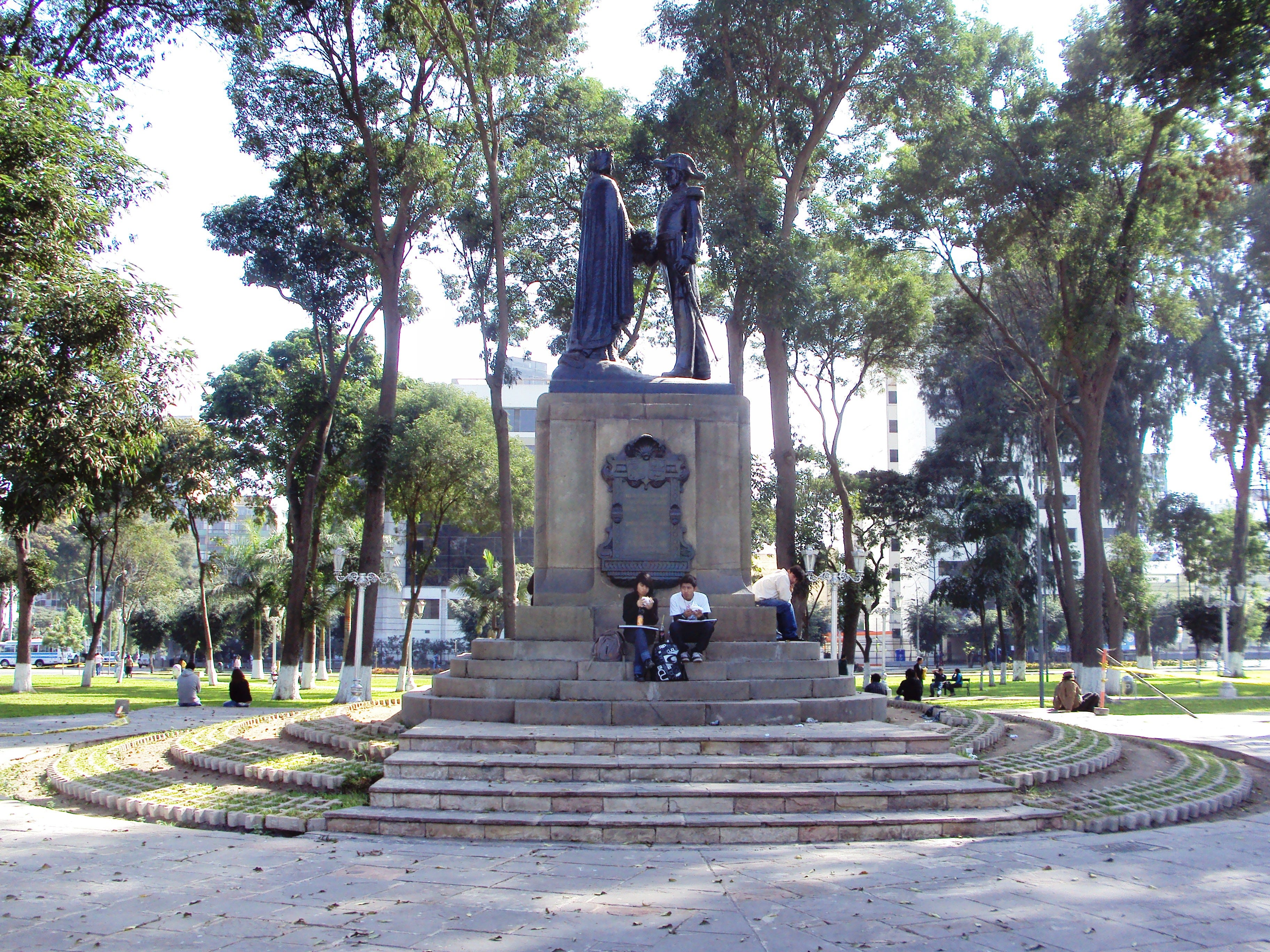
All around, the boulevards were dotted with monuments to fallen heroes from this war. Streets carried the names of battles, admirals, foreign allies. Conversations about the 1879-1884 conflict unfolded with the immediacy of unresolved grievance.
This atmosphere of historical memory existed alongside a more immediate fear — the sense that another conflict, modern and ideological, could soon consume the city in ways as terrifying as the Chilean occupation had once threatened to.
I was no stranger to the grip that memory and grievance can exert on a people. My family comes from Mississippi, where history has never stayed in the past.
Later that year, when I traveled to Chile to work on a film near the Peruvian border — in territory that had once belonged to Peru — I began to understand something larger about the afterlife of war and national humiliation.
In Peru, the War of the Pacific existed outside of time. It lived in monuments, street names, schoolbook mythology, and the country’s symbolic landscape.
But in Chile, the war barely surfaced.
There, it occupied the terrain of ordinary history: a chapter turned in a textbook, a distant military success, largely absorbed into the settled narrative of the nation.
A few miles away across the border, the same century-old war carried the charge of unfinished business.
Victors’ commemorations might merit a few pages in a text.
Losers remember deeply.
And lest I imagine this fixation with historical grievance to be uniquely Peruvian, another South American detour — this time north into Ecuador — deepened the pattern.
Just beyond the border crossing near Piñas stood a solemn but unmistakably modern sculptural monument dedicated to the heroes of Panupali, Ecuadorian soldiers who fought and died defending their country during the brief 1941 war with Peru — a conflict that left Peru in possession of some 77,000 square miles of Ecuadorian jungle.
What felt familiar was not simply the monument itself, but the emotion surrounding it.
In Peru, the national mythology revolved around territory lost to Chile. In Ecuador, memory gathered around territory lost to Peru.
And yet, I could scarcely remember hearing the 1941 conflict mentioned at all in Peru.
Each nation carried its own map of historical pain, illuminated at the points where dignity, land, or identity had once been stripped away.
Sometimes those maps become literal. Under Hugo Chávez and later Nicolás Maduro, Venezuelan maps often depicted the Essequibo region of neighboring Guyana as rightfully Venezuelan territory. In maps printed in Guatemala City during certain periods of my travels, Belize appeared not as a sovereign nation at all, but as unresolved Guatemalan territory.
Those maps were psychological as much as geographic.
They revealed the places where the past had never fully settled.
In Greenwood, Mississippi, on the grounds of the Leflore County Courthouse where my great-grandfather Samuel Lizzie Gwin once tried cases, there stands an imposing Confederate monument erected in 1913 in memory of another ancestor, Brigadier General and former Mississippi Governor Benjamin G. Humphreys.
I remember crossing the Yazoo River bridge as a child with my grandmother Saizie holding my hand. The courthouse loomed above us near the rusted steel trestle, and she pointed toward a window where my great-grandfather’s desk had once stood in the prosecutor’s office. Then she gestured toward the monument itself, explaining with quiet familial pride that it had been erected in honor of “our kin.”
That phrase stayed with me for years.
Not because my grandmother spoke with bitterness — she did not — but because even as a child I could sense the monument represented something larger than simple remembrance. It was part of an emotional landscape in which history remained physically present, embedded in courthouse lawns, civic architecture, inherited stories, and the moral atmosphere of place.
There was something strangely parallel in all of these landscapes of memory — the grandeur and the decay, the pride and the exhaustion, the insistence on prominence.
In Greenwood, the Confederate monument rises directly beside the courthouse lawn in the symbolic center of civic life, impossible to miss as one crosses the Yazoo River bridge or approaches from Cotton Row. Yet the recently dedicated memorial to Emmett Till — whose death helped catalyze the modern Civil Rights Movement — occupies nothing like the same civic prominence. It sits nearer the old rail depot and the tracks, powerful but spatially peripheral, as though the geography of memory was still negotiating which histories deserve the central pedestal and which remain closer to the margins.
Though county officials voted in 2021 to relocate the Confederate monument, Mississippi’s layered preservation requirements — involving historical approvals, engineering studies, and cost assessments — have slowed the process to a crawl. For now, the statue still stands before the courthouse, held in place by administrative inertia and the unresolved weight of the past.
What strikes me is how familiar that sensation feels.
I remember walking Avenida Petit Thouars in Lima amid the broad ceremonial medians, monuments to 19th century sacrifice, aging infrastructure, and the uneasy coexistence of civic pride and unresolved trauma. The gnarled tree roots pushing upward through the pavement there felt metaphorical even then: history refusing burial, continuing to distort the surface decades later.
I thought about this again as I watched the choreography of the president’s trip to China — the immense halls, synchronized ceremony, military precision, and language of respect layered atop strategic distrust.
To many Americans, the tensions between the United States and China are framed primarily through the vocabulary of the present: trade imbalances, microchips, tariffs, Taiwan, fentanyl, artificial intelligence, naval power.
But for China, much of this unfolds against an older and more psychologically foundational backdrop: what is commonly referred to there as the “Century of Humiliation,” the period beginning with the Opium Wars in which foreign powers carved concessions from a weakened Qing dynasty through military force, unequal treaties, economic domination, and internal collapse.
In American discourse, the Opium Wars are treated as distant imperial history, one chapter among many in the story of nineteenth-century colonial expansion.
In China, the memory lives in textbooks and museums and the scaffolding of Chinese nationalism: the conviction that weakness invites dismemberment, that foreign powers exploit internal disorder, and that sovereignty must never again be surrendered. Implicit within that worldview is another possibility — that historical humiliation might someday be answered not simply through recovery, but reversal.
Watching the pageantry surrounding Donald Trump’s arrival, I thought less about diplomacy than historical psychology.
Trump’s political vocabulary is saturated with humiliation and restoration: America being “ripped off,” “laughed at,” “disrespected,” diminished by unfair trade, porous borders, weak leadership, bad deals. His appeal rests partly in his promise to reverse a story of decline and recover lost stature.
It is this man who muses about building an American Arc de Triomphe and a gilded ballroom worthy of the last French kings, who surrounds himself with the aesthetics of excess and imperial grandeur, who is drawn not merely to the exercise of power but to its theatrical display. His political rallies are rituals of restoration — collective acts of reclamation staged beneath enormous flags, martial music, and repeated invocations of national humiliation.
And in Beijing, he was being welcomed by a government whose identity has been shaped by the determination that China never again experience the weakness and fragmentation associated with the Century of Humiliation.
Grievance transformed into political energy, humiliation converted into narratives of restoration and renewed greatness — the emotional architecture was recognizable on both sides of the table.
And hovering over the encounter was a historical irony.
In the nineteenth century, Britain forced opium into a weakened China in the name of commerce and imperial access, helping to ignite the long unraveling that Chinese history remembers as humiliation. Nearly two centuries later, American officials accuse Chinese precursor manufacturers of helping fuel a synthetic opioid crisis that has devastated communities across the United States.
Perhaps the most powerful intoxicant is neither opium nor fentanyl but grievance itself.
The intoxicating promise that history’s humiliations can be undone through strength, spectacle, dominance, and the recovery of lost stature.
Monuments.
Imperial aesthetics.
National mythologies.
Children leaping with tiny flags.
But history rarely resolves itself so cleanly.
The roads named for old battles remain.
The monuments endure.
The maps stay psychologically unfinished.
And nations, like people, often discover that grievances are seldom healed. More often they are inherited — absorbed into landscapes, rituals, political language, and collective memory, resurfacing generation after generation in new forms, new conflicts, and new dreams of restoration.
Aaron Woolf is a filmmaker and community developer based in Elizabethtown, New York. Best known for directing the Peabody Award–winning documentary King Corn, he has also been deeply involved in local projects that strengthen Adirondack communities. His work includes reopening the historic Deer’s Head Inn, serving on the town planning board, helping to found the Adirondack Community Recreation Alliance, and leading the redevelopment of Elizabethtown’s historic pharmacy building into a multi-use center promoting small businesses and community life.
Excellent article. These grievances are imbedded. It feels sometimes like the Civil War is still going on. Of note is how everyday citizens
who are the soldiers in these conflicts need the symbols to justify why the many died when it is mainly the greedy and selfish and wealthy and economically powerful that cause the conflicts.
So much truth here and well written. How WWI begat WWII yet WWII and the Marshall Plan brought us a time of relative peace and prosperity. “The evil men do lives after them while the good is oft interred with their bones.” Why can’t we learn form these examples?