
GUEST ESSAY: After life
Imagining heaven from an earthbound place
Please consider supporting The Front Page with a paid subscription: HERE
By AARON WOOLF
The worst speech I ever gave began with a joke that was not funny.
The day was bright and cool. I was engaged but not yet married, and I had been invited to lead some kind of program in the theater at the New School for Social Research in New York City. The room was full. I was the keynote speaker.
Who had invited me? What was I doing there?
I had an idea that I would begin by describing the peculiar authority conferred upon documentary filmmakers. You spend several years researching a subject—immigration, sports, agriculture, to name a few recent examples—traveling to locations and talking to people who know far more about it than you do. Then you spend months in a dark editing room, poring over what you have harvested. By the end, you have accumulated something resembling an advanced degree.
Except you haven’t.
In truth, I explained, you are not an expert at all. You are more like the actor in the old television commercial who recommends a prescription medication before admitting, without apparent irony, “I’m not a doctor, but I play one on TV.”
So I had begun my keynote address by telling an audience of actual experts, professionals and graduate students that, although I appeared to be qualified to speak to them, I wasn’t.
I think I thought this was funny.
The silence that followed induced something close to an out-of-body experience. I felt the blood rush into my face. After that, I remember almost nothing—not what I said next, nor how long I went on. I was supposed to speak for half an hour. Perhaps eight minutes in, I heard myself say, “…and that’s all I have to say,” words that at least had the virtue of being true.
An author I recognized—was it Fran Lebowitz?—saw me reeling, practically swimming toward the wings of the auditorium. I must have resembled an excessive drinker trying to walk a straight line for a state trooper, my path describing a broad and hopeless arc.
“That looked rough,” she said.
I stumbled out of the theater into the dazzling afternoon and began to walk. I walked for miles, without any clear sense of where I was going, until I found myself stepping onto the Brooklyn Bridge. Long before I became a filmmaker, I had written a long undergraduate paper about that bridge. Perhaps there was some destiny in returning to it. Or perhaps it was simply there.
Nothing felt entirely conscious as I climbed toward the gothic tower, the light almost blinding in its intensity. I was numb, disembodied, still adjusting to the strangely brilliant day. I felt as if I were floating.
“Aaron?”
At the crest of the bridge, a voice broke through my stupor.
It was Keith, an old friend, appearing so unexpectedly that for a moment I could not quite place him.
“Are you okay?” he asked. “You look weird.”
I told him I had flubbed a speech.
“Did anyone get hurt?”
“What? No.”
“Did anyone die?”
“No, of course not.”
No one had died. This was useful perspective, if not exactly the kind I had been looking for.
Several years later, sometime around 2012, I was invited to speak at an outdoor food festival outside Oshkosh, Wisconsin. For a while after King Corn was released, I appeared regularly at gatherings associated with the rising good-food movement, nowhere more often, it seemed, than in the Corn Belt and its midwestern periphery.
I had grown more comfortable with public speaking, but I still preferred the crutch of a screening. When I showed a film, I could riff on its themes or, in a pinch, ask the audience what they thought of a given moment. That allowed me to turn the spotlight around.
At Oshkosh there would be no screening. For reasons that now escape me, I decided I would speak about heaven.
The first time I tried to picture heaven, I was in Iowa.
I arrived there in 1990 on a motorcycle. I had been living in Mexico City and applied to graduate school at the University of Iowa on the advice of one of my undergraduate professors.
“They have a cool program there,” he told me. “I think you’ll like it. You might even like Iowa.”
The ride had been smooth for most of the journey, but somewhere in Missouri I encountered a series of thunderstorms I could not outrun. Before I found an overpass to hide beneath, everything—the motorcycle, the saddlebags, my clothing—was soaked. I waited for the storm to pass, dripping beside the bike, then gave up and rode north through the rain.
Not long after I crossed the Iowa line, the clouds opened and the low western sun poured through.
I was entering a landscape for which I had no reference. It looked nothing like the Adirondacks. The flatness I had expected was a long sequence of rolling hills, the drying corn stalks lit amber by the late-summer sun. Great round bales of hay cast shadows across the fields. The country seemed to widen and deepen all the way to the horizon. Wet, chilled and entirely alone, I could not quite believe what I was seeing.
Then I began to notice the bumper stickers.
Is this heaven?
Iowa’s answer to the I Love New York campaign came from “Field of Dreams,” the recent hit movie in which Shoeless Joe Jackson and a team of long-dead ballplayers emerge from a cornfield. Joe asks Kevin Costner’s character whether he has arrived in heaven.
No, he says. It’s Iowa.
Somehow the question became attached to my own experience of Iowa, and later to the making of King Corn. I wondered whether Shoeless Joe Jackson’s heaven would resemble anyone else’s.
My own heaven, I felt fairly certain, was not an Iowa cornfield composed like a Grant Wood painting. Mine was a snowfield with a glacial cirque rising behind it: a cold, dry, blue-sky day in a landscape of untrammeled alpine white.
The argument I planned to make in Oshkosh was that heaven must be subjective, its contours shaped to the desires of each new arrival. I was still developing this theology when the festival organizers, having run out of drivers, asked me to pick up another speaker at the airport.
Joel Salatin was a hero of the food movement—a champion of regenerative polyculture farming and an evangelical Christian who found spiritual meaning in the wholeness of the natural world. As we drove back toward the festival, I told Joel about my theory—that heaven might look different to each of us.
Joel explained, with measured forcefulness, that heaven was not customizable.
“I’m a biblical literalist,” he said.
For Joel, heaven could be known only through scripture. It was the dwelling place of God and the angels, a realm of eternal rest and reward, culminating in a restored physical world where God would live among humanity and suffering, pain and death would end.
I realized that I had been thinking mostly about the scenery.
“That’s covered too,” he said.
Scripture, it turned out, contained specifications. The Book of Revelation describes a vast city, equal in length, width and height, with streets of gold and gates of pearl. There is no night, and the city has no need of the sun or moon. Of all this, only the crystal-clear river seemed as though it might belong in my heaven, perhaps fed by meltwater from the glacial cirque.
We arrived before I could ask what one saw when one looked up toward the heavens—in heaven.
Of course, I had already experienced the starless void, the sensation of leaving my body, an ascent toward a gothic tower, a disembodied voice and a blinding white light. Unfortunately, all of them belonged to the worst afternoon of my speaking career.
I had considered seminary more than once when I was younger, but something about eternal bliss had always troubled me. Bliss seemed to require an end to striving, an end to surprise, perhaps even an end to time. What did perfection leave to hope for?
David Byrne imagined heaven as a place where nothing ever happens. The perfect moment ends and begins again. Nothing changes. Nothing is lost.
It sounds seductive, and faintly horrifying.
There was something about Byrne’s heaven that made it closer to the city Joel described than either of them might have wished. Both were complete. Nothing remained to be discovered. No one needed to wonder what happened next.
Oddly, my understanding of the afterlife has been shaped as much by the great secularists I admire as by spiritual thinkers. Carl Sagan once wrote, “I would love to believe that when I die I will live again.” But he knew of no evidence that some thinking, feeling, remembering part of him would continue.
What followed was not a cold dismissal of heaven so much as an aching inventory of everything he hated to leave. He wanted to grow old with Annie, to see his children become themselves, to meet grandchildren not yet conceived. He wanted to know what we would discover on other worlds and how the unresolved story of humanity would turn out.
Sagan did not want eternal rest. He wanted eternal wonder. He wanted to know what happened next.
And here I was, years after his death, reading him. Sagan had not lived to see the future he longed for, but something of his wonder had. It had reached me. His attention had survived him and entered my own.
The dead may not continue to watch the world, at least not in any way I can claim to understand. But their way of watching can remain with us.
This very afternoon, I ran into my friend Cynthia at the bike shop in Elizabethtown. She told me that her partner, Rusty, had died last year. I had not known. I responded, somewhat ham-handedly, that I was on my way home to write about heaven.
“Well, I’m an atheist,” she said.
Then she told me that a few weeks after Rusty died, a milkweed pod had burst open in the living room they had shared. Its seeds drifted down and settled over a photograph of him.
My sister Sara—an atheist—and I, a quasi-Christian of uncertain standing, have often talked about the days after our parents died. Everywhere we went, it seemed, animals stopped in their paths and looked knowingly at us. But they seemed to pause for longer than animals had any reason to pause, fixing us with the unnerving attention of creatures that knew something we did not.
I don’t think it occurred to either of us that they were simply animals pausing. Nor did we stop to reconcile their behavior with our respective theologies. We accepted without question that they were communicating on behalf of our parents—or, quite possibly, that they were our parents.
I cannot prove any of this—not that Rusty opened the milkweed pod, or that our parents inhabited those animals, or that anything waits for us after death. But uncertainty does not empty such moments of meaning. It may be what allows the meaning to enter.
After life comes death. After death comes memory.
Memory is imperfect and persistent. It attaches itself to words, to landscapes, to photographs, to the gaze of an animal standing motionless on a path. We keep looking for the dead and, every once in a while, their world seems to look back.
These moments do not erase the boundary between presence and absence. For an instant, they make it permeable. Memory, coincidence and longing fall into alignment, and some ordinarily invisible strand becomes not only visible but almost knowable.
I do not know if that is heaven.
But it may be the closest I have come to seeing it.

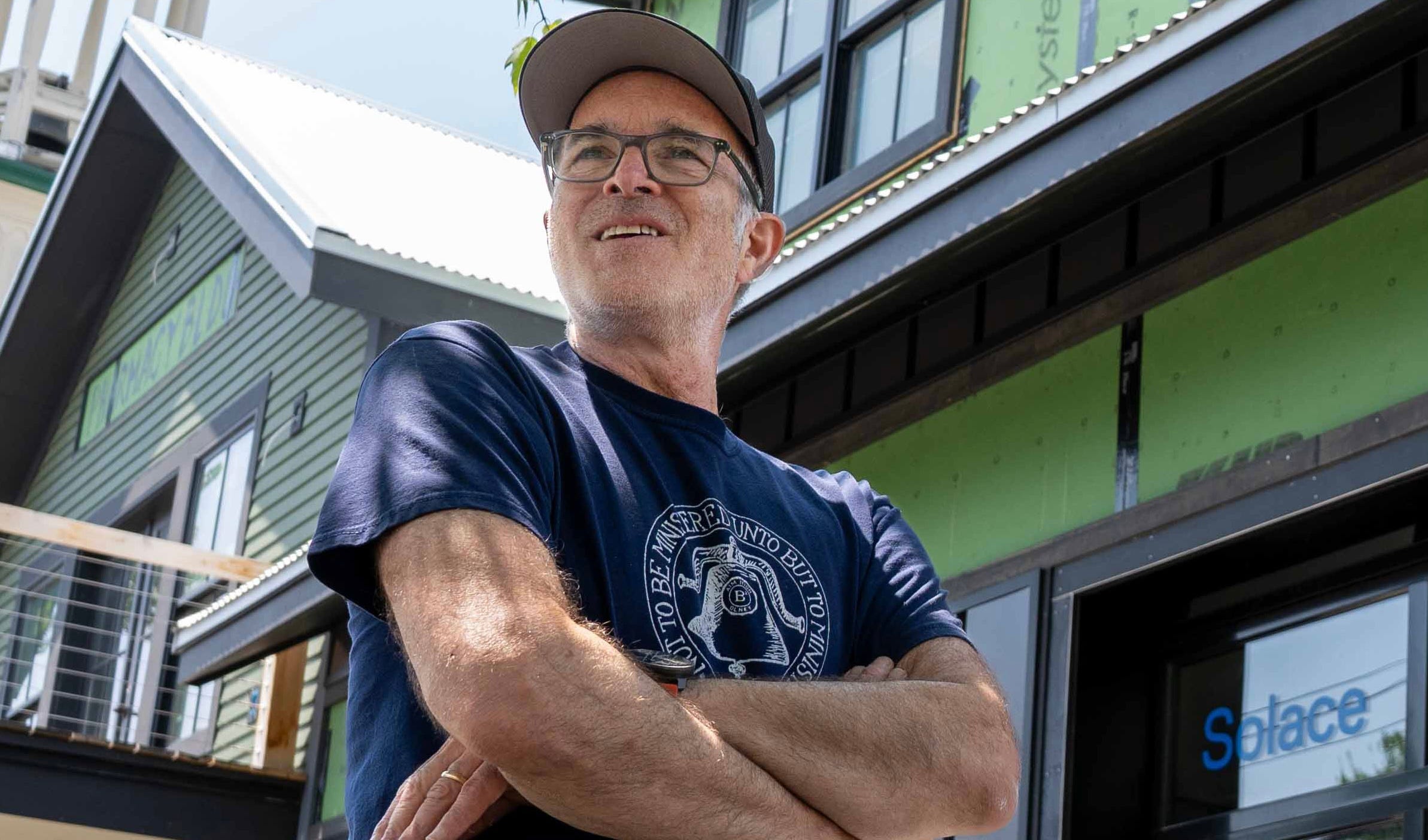
Aaron Woolf is a filmmaker and community developer based in Elizabethtown, New York. Best known for directing the Peabody Award–winning documentary King Corn, he has also been deeply involved in local projects that strengthen Adirondack communities. His work includes reopening the historic Deer’s Head Inn, serving on the town planning board, helping to found the Adirondack Community Recreation Alliance, and leading the redevelopment of Elizabethtown’s historic pharmacy building into a multi-use center promoting small businesses and community life.
Thank you! I have thought forever ( as a Christian of indeterminate theology) that heaven as depicted in scripture seems endlessly BORING!!! Imagine hanging out with "nice" people for all eternity! It seems a balance to hell in Satre's No Exit -- like being stuck in a dentist's waiting room with the people who most annoy you. Not your enemies -- that's energizing -- but the people who just . . annoy you. Anyway, I have come to believe that the Lord's prayer has the answer: Thy kin-dom come, thy will be done, ON EARTH. . . !"
Religious believers have their idea of heaven and the afterlife to comfort them. Those of us who don’t can rely on science. Einstein taught us about the conservation of energy. It cannot be destroyed, or otherwise made to vanish, but it can change form. Our bodies and brains run on tiny electrical charges, a form of energy. When a body dies, that activity stops within the body. Where does the energy go? Somewhere. I take comfort in that.